NeuraBI
54Measurements compared
- Within the study interval
- 48
- Above
- 5
- Below
- 1
Coriobacteriaceae bacterium BV3Ac1
Measured: 0.000208%
Reference interval: 0% – 0.000994%
MICROBIOME INTELLIGENCE FOR BRAIN HEALTH
NeuraBI is developing an AI-powered platform that brings shotgun metagenomic and clinical data together to explore personalised insights and complementary approaches to neurological care.
In development · Recruitment open. Not yet available for clinical use.
Step 1 of 6
Your gut is home to a community of tiny living things called microorganisms. Together, they make up your gut microbiota.
Move your pointer to stir themTouch the screen to stir them
Step 2 of 6
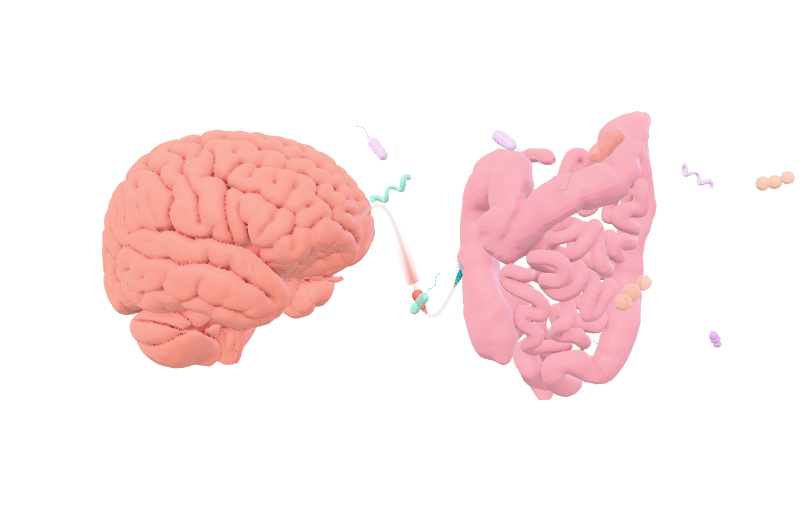
Your gut has its own dense network of nerve cells, called the “second brain”. Signals travel all the time along this network, which connects the gut and the brain: this is the gut–brain axis. Choose a route to see it.
Nerves, including the vagus nerve, carry messages between the gut and the brain. Communication travels in both directions.
The microbiota interacts with the gut immune system, modulating immune and inflammatory signals that can also affect processes in the brain.
Gut microorganisms produce molecules called microbial metabolites from the food we eat. Microbial metabolites can travel freely through the human body, influencing several of its functions, including brain health.
Step 3 of 6
Each condition affects the nervous system in its own way. Choose one to see a simplified picture.
In Alzheimer’s disease, some proteins build up abnormally in the brain and the connections between nerve cells progressively deteriorate. This can impair memory and other cognitive abilities.
In Parkinson’s disease, the neurons that produce dopamine, a chemical messenger essential for controlling movement, progressively degenerate. In some people, gut problems such as constipation can appear several years before the motor symptoms.
In multiple sclerosis, the immune system attacks myelin, the protective coating of nerve fibres in the central nervous system. This damage can slow or interrupt the transmission of nerve signals, causing problems with movement, sensation, vision and balance.
Scientific studies have observed differences in the gut microbiome of people with these conditions. It is not yet known whether they are a cause, a consequence or both.
Understanding the connection between gut and brain better is one of the starting points of the research. NeuraBI is a research project. The information on this website is not intended for the prevention, diagnosis or treatment of any disease.
Explore the scienceStep 4 of 6
This is how NeuraBI works.
You provide a stool sample, which a specialised laboratory analyses by sequencing the microbial DNA. NeuraBI then processes and interprets the data produced.
NeuraBI compares your microbial profile with a reference population and your clinical data.
Your doctor signs in to a dedicated portal, where they can see your profile and the complementary therapy proposal generated by the NeuraBI system. They review the results and consider which recommendations to discuss with you. An AI assistant supports them in consulting the scientific sources, but clinical decisions always remain theirs.
After reviewing and approving the results, your doctor makes the report available in your personal portal. It includes a summary of your gut microbiota profile, a clear explanation of the results and the recommendations on complementary therapy. The portal keeps and compares later reports, so you can follow how your gut profile changes over time.
Step 5 of 6
Defining the study protocol and the ethical and regulatory approval pathway. Building a network of collaborations with neurologists and suppliers specialised in personalised microbial products.
Not yet available for clinical use.
Step 6 of 6
Our aim is to turn complex gut microbiome information into a clear explanation you could discuss with your clinician.
What this could mean for youFor clinicians & researchersWe’re developing a research tool to organise microbiome findings alongside clinical context, with evidence and uncertainty made visible.
Explore the clinical perspectiveWe welcome conversations with clinicians, researchers, patient organisations and strategic partners. Start a conversation
WHY THIS MATTERS
Research increasingly points to interactions between the gut microbiome, immune pathways and the nervous system. Yet translating complex microbiome measurements into individual, clinically interpretable insights remains challenging. NeuraBI is being developed to help address this gap.
Explore our approachSEE THE OUTPUT
Explore an illustrative report generated from a synthetic profile. See the measured amounts, study comparison intervals and explanations together.
Open the example reportMeasured: 0.000208%
Reference interval: 0% – 0.000994%
WHO WE WORK WITH
Find out how to contribute to research on the gut microbiome and neurological health.
Find out how to take partCliniciansDiscover the NeuraBI platform and the opportunities for clinical collaboration and for taking part in the pilot clinical study.
Discover the project and collaborate with usScientific & industrial partnersWe are looking for collaborations with research institutes, specialised laboratories and companies developing personalised microbial products, to advance research and innovation in neurological health.
Let’s explore new opportunities togetherInvestorsDiscover how NeuraBI brings together artificial intelligence and gut microbiome research to develop personalised complementary therapeutic approaches, from clinical validation to market entry.
Discover the project and the investment opportunitiesWORK WITH US
We welcome conversations with clinicians, researchers, patient organisations and strategic partners.
Start a conversation